

Every Pregnancy Boost Funds helped Baitulmaal turn local strength into stronger maternity care, by bringing skilled staff, essential services and referral pathways closer to mothers who need them.
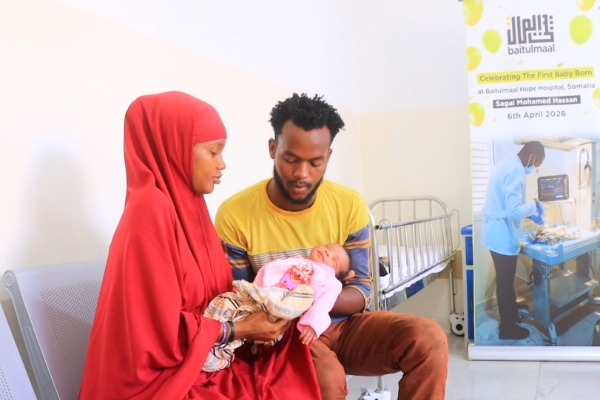
When Nasra arrived at Baitulmaal Hope Hospital in Mogadishu, Somalia, she was about to give birth after spending her entire pregnancy without a single prenatal visit. Not by choice. Care had simply been out of reach. For months, she carried her baby without the reassurance of routine antenatal care or knowing what would happen if complications arose.
But when she arrived at Hope Hospital, something changed. With trained doctors and nurses beside her, Nasra safely delivered a healthy baby girl, Sagal, one of the first babies born at the newly opened hospital. Sagal received essential newborn care immediately. “This is the first time I felt truly safe giving birth,” Nasra said.
Her story is personal, but the gap behind it is much larger. In 2023, Somalia’s maternal mortality ratio was estimated at 563 deaths for every 100,000 live births. Conflict, displacement, climate shocks and disease outbreaks continue to make healthcare difficult to reach for many families. Much of what is needed to make pregnancy and childbirth safer is already known. The challenge is not only knowing what works. It is making sure a mother can actually reach it when she needs it.
Bringing care closer
In November 2025, Baitulmaal opened Hope Hospital in Garasballey District, Mogadishu, to expand healthcare for internally displaced people and underserved families. The 30-bed hospital provides adult, pediatric and maternity services and is equipped to serve approximately 50 to 100 patients each day. At its heart is a dedicated maternity unit made possible in part through a the Gates Foundation contribution to Every Pregnancy’s Boost Fund.
Women can access antenatal and postnatal care, skilled delivery services, emergency obstetric surgery, including cesarean sections, and reproductive health services. But safe maternity care takes more than a building. A mother needs somewhere she can reach, health workers need the tools and environment to provide quality care, complications need to be recognized and treated quickly, and when more specialized support is needed, there must be somewhere to go next.
At Hope Hospital, those pieces begin to come together: maternity care close to the community, trained health professionals, emergency obstetric services and a pathway to more specialized treatment when needed. Through a referral partnership with Jazeera University Hospital, patients can continue to higher levels of care when necessary. The arrangement is also intended to keep fees low and waive them for people facing financial hardship, including internally displaced families. That matters because a referral only works if a mother can actually use it.
For a mother, the questions are practical: Can she reach care? Is someone trained there to help her? Can complications be treated? And if she needs more specialized care, can she get there?
Building on local strength
Baitulmaal did not begin supporting mothers and newborns with the opening of Hope Hospital. The organization already brought humanitarian and healthcare experience, local relationships and the ability to work in underserved communities. The partnership did not create that local strength; it helped Baitulmaal expand the care it could provide.
Resources helped strengthen maternity capacity at Hope Hospital, while Baitulmaal brought the local experience, relationships and trained Somali health professionals needed to turn those resources into care. That distinction matters. Organizations closest to communities already understand many of the barriers mothers face. The opportunity is to make sure they have the resources, services and connections needed to respond.
Hope Hospital offers one example of what that can look like: local leadership supported to provide skilled maternity care, respond to emergencies and connect women to higher levels of care when necessary. The wider lesson is simple: proven maternal health care can reach more women when the organizations closest to them have what they need to deliver it.
When resources become care
Today, Hope Hospital has new capacity to provide antenatal and postnatal services, skilled delivery and emergency obstetric care in a community where access has been limited. Those numbers tell one part of the story. Nasra and Sagal show what that capacity means in practice.
After an entire pregnancy without prenatal care, Nasra reached a facility where trained professionals were there when she went into labor. She delivered Sagal safely, her daughter received essential newborn care, and after months of uncertainty, Nasra could finally say that she felt safe giving birth.
For Nasra, the funding, hospital infrastructure and partnerships behind the maternity unit were not abstract. They meant there was somewhere safe to go when she needed care. Her experience points to a challenge far beyond one hospital: proven care can exist, but it only makes a difference when mothers can reach it.
That is what the Every Pregnancy coalition is working with partners like Baitulmaal to change — strengthening locally led efforts so proven maternal and newborn care can reach more mothers and babies, where and when it is needed most.
Help proven care reach further
Strong local organizations already hold the experience, relationships and trust needed to serve their communities. Through the Every Pregnancy coalition, partners can connect those strengths with the resources and expertise that help proven maternal and newborn care reach further.
Partner with Every Pregnancy →