
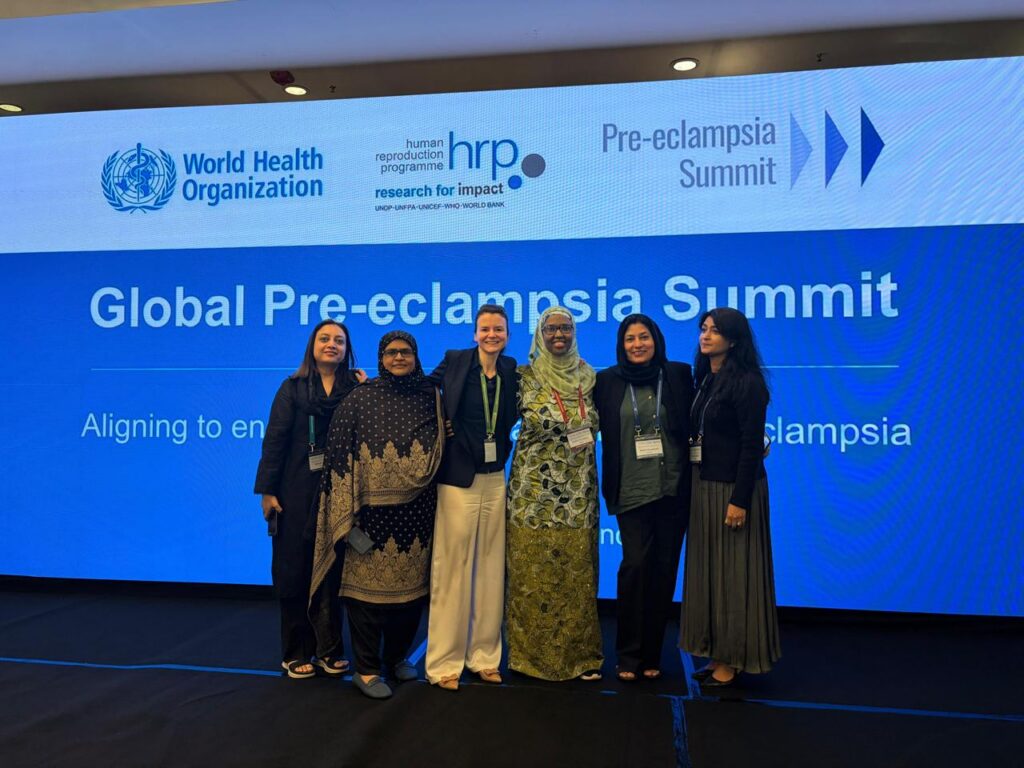
Authors: Marleen Vellekoop (Every Pregnancy), Prof Hadiza Galadanci (The Africa Centre of Excellence for Population Health and Policy (ACEPHAP), Dr Sidrah Nausheen (Aga Khan University), Hannah King (Children Not Numbers), Mukhtar Karim (Lady Fatemah Trust)
Every year, complications from high blood pressure during pregnancy contribute to approximately 42,000 maternal deaths and 500,000 fetal and newborn deaths. A new global roadmap offers an opportunity to change that. But its success will depend on whether we can turn global commitments into better care for women everywhere.
For millions of women, pregnancy is a time of great apprehension coupled with anticipation of joy. But it can also bring a dangerous complication that develops with few obvious warning signs: high blood pressure.
One of the most serious conditions is preeclampsia, a pregnancy complication involving high blood pressure that can damage vital organs and, without timely care, become life-threatening. In severe cases, it can lead to seizures, known as eclampsia, and threaten the lives of both mother and baby. Pre-eclampsia can lead to long-term kidney and heart disease, which is especially concerning in low-resource settings where women may struggle to access the lifelong care they need. Uncontrolled high blood pressure can also cause a stroke, leaving mothers with lifelong disabilities
We already know how to prevent and manage many of these complications. Regular antenatal care, blood pressure monitoring, urine testing, a simple daily tablet of aspirin, appropriate medicines, timely referrals and skilled emergency care can make an enormous difference.
Yet progress has been painfully slow.
Unlike postpartum hemorrhage, which has benefited from growing global attention and coordinated investment, hypertensive disorders of pregnancy have received comparatively limited attention. Research and innovation have been underfunded, essential medicines and diagnostics remain inaccessible in many settings, and proven approaches are not consistently translated into routine healthcare. In under-resourced settings, women often seek care when their condition is already severe, increasing the risks for both mother and baby.
The consequences are profound. Women continue to die not necessarily because effective care is unknown, but because the systems needed to deliver it are missing or inadequate.
This is both a medical challenge and a failure of equitable access.
A global milestone: Moving from fragmented efforts to a shared agenda
The launch of the “Global Roadmap for Hypertensive Disorders of Pregnancy from 2026 to 2035 and Beyond” represents an important milestone in global maternal and newborn health.
Developed through a process led by the World Health Organization (WHO) and its Human Reproduction Program (HRP), the roadmap builds on the Global Preeclampsia Summit held in Kigali, Rwanda, in May 2026. The summit brought together stakeholders from more than 50 countries, including Every Pregnancy, researchers, clinicians, governments, manufacturers, funders, advocates and women with lived experience.
The roadmap establishes five interconnected priorities:
- Research and innovation: Develop better ways to prevent, detect and treat hypertensive disorders of pregnancy.
- Norms and standards: Strengthen the evidence and guidance that inform quality care.
- Access to health products: Ensure essential medicines, diagnostics and technologies are affordable, available and of assured quality.
- Implementation: Support countries and healthcare providers to deliver effective interventions consistently and at scale.
- Advocacy and accountability: Build the political commitment, financing and public demand needed to sustain progress.
These priorities may seem straightforward. Their significance lies in how they fit together. Too often, global health efforts address individual parts of a problem without addressing the barriers that connect them. We develop clinical guidelines without ensuring healthcare workers have the tools, training or resources to implement them in conflict or vulnerable settings. We celebrate new technologies without resolving the affordability, procurement and supply-chain challenges that determine who can access them.
The roadmap recognizes that progress in one area depends on progress in all the others.
This is particularly important in today’s global health environment, where financial pressures and competing priorities make fragmented investments increasingly difficult to justify. Greater impact will not necessarily come from creating more initiatives. It will come from aligning existing efforts, identifying the most consequential gaps and directing resources toward solutions that can deliver results at scale. The roadmap provides a shared direction for doing exactly that, with priority actions and milestones extending to 2035 and beyond.
It is a significant shift: from recognizing the problem to organizing a collective response.
The real challenge: Closing the distance between evidence and access
Consider a pregnant woman living in a rural community or an area affected by conflict.
She may need a routine blood pressure check, but the nearest health facility could be hours away. Even if a complication is identified, the facility may lack essential medicines and supplies, trained personnel or a functioning referral system. A hospital capable of managing a severe emergency may be difficult or dangerous to reach.
Her outcome depends on far more than whether an effective medicine or clinical guideline exists.
It depends on whether she can access antenatal care, whether she trusts the services available, whether healthcare workers recognize the warning signs, and whether the health system can respond quickly when complications develop. When complications occur, outcomes depend heavily on the care available, as many women with pre-eclampsia need intensive care. Pre-eclampsia can also cause premature birth and low birth weight, but many hospitals lack the equipment and trained staff needed to care for these newborns.
These barriers are particularly acute in fragile and humanitarian settings, where disrupted supply chains, workforce shortages, insecurity and weak referral systems can turn a manageable complication into a life-threatening emergency.
This raises an important question for the global health community: “Are we investing enough in the last mile between a proven solution and the woman who needs it”?
Why this roadmap matters to our coalition
Our coalition brings together over 80 locally rooted, faith-inspired NGO partners, united by a shared commitment to improving maternal and newborn health, particularly for women living in underserved and crisis-affected communities.
Our partners have deep relationships with the communities they serve. They understand the practical barriers women face, from distance and cost to insecurity, cultural expectations and limited trust in healthcare services.
They also understand that improving maternal and newborn health requires more than delivering individual interventions.
A woman with preeclampsia may need early identification during antenatal care, medication to manage her condition, timely referral to a hospital and skilled care during childbirth. Each step depends on the others.
That is why our coalition will connect the global maternal health agenda with organizations that can translate it into action in communities that are too often overlooked.
We can connect evidence and innovation with implementation, local experience with global decision-making, and new sources of philanthropy with practical opportunities to improve care.
At a time when global health financing is under pressure, these connections are especially important.
Turning the roadmap into action: Where we can make a difference
We see four areas where our coalition can make a meaningful contribution.
1. Translating global priorities into locally relevant solutions
Global roadmaps provide direction, but implementation happens within countries, health systems and communities. Our partners help translate the roadmap’s priorities into practical improvements in care, particularly in underserved and humanitarian settings.
2. Bridging the gap between innovation and implementation
The roadmap highlights the need for new medicines, diagnostics and models of care. But it also recognizes that promising innovations can remain out of reach for years. Our coalition partners work to bridge this gap by helping to identify which solutions are most appropriate, how they need to be adapted and what it will take to introduce them effectively.
Equally important, implementation experience can inform future innovation. This two-way relationship between innovation and implementation is essential if the next generation of maternal health solutions is to reach those who need them most.
3. Mobilizing new voices and new resources
The roadmap rightly identifies advocacy, political commitment and financing as essential to progress. We have seen through our campaigns how faith-inspired philanthropy can mobilize communities around a shared commitment to mothers and newborns. Our coalition brings together organizations and trusted community voices with the potential to engage donors and supporters who have not traditionally been central to maternal health philanthropy.
We also have an opportunity to make the issue more accessible to the wider public. Preeclampsia may be unfamiliar to many people, but the underlying question is simple: why should a woman face a life-threatening complication because she cannot access a blood pressure check, an essential medicine or timely emergency care?
4. Building collaboration, learning and accountability
One of the most important contributions of the roadmap is its recognition that progress requires coordination across organizations, disciplines and sectors. Our coalition offers a platform for partners to identify shared priorities, learn from one another and work toward common outcomes.
By bringing together implementation experience across different countries and contexts, we can help identify what works, what remains difficult and where additional investment or technical support is needed.
Our NGO partners also play a critical role in generating and using data from routine service delivery to identify gaps in care, by supporting health care workers to monitor outcomes and continuously improve the quality of services. By bringing together and sharing evidence and implementation lessons across different settings, our coalition can help governments, researchers and other healthcare organizations understand what works, for whom and under what conditions. This collective learning can inform policies, guide investments and accelerate the adoption of effective approaches well beyond our own coalition.
5. Shaping communication, research and implementation from the ground up
Locally rooted NGOs have a role that goes beyond delivering services. They shape how preeclampsia is understood, studied and addressed. Locally rooted organizations are often the first to hear why women delay antenatal visits, mistrust a clinic or dismiss warning signs such as severe headaches, swelling or blurred vision.
That insight is essential to effective health communication. Messages about blood pressure checks and danger signs land best when they come through trusted voices: community health workers, faith leaders, midwives and women who have lived through the condition themselves.
NGOs can also make research more relevant by bringing frontline questions into study design, supporting community-based data collection, and ensuring that evidence reflects the realities of rural, fragile and crisis-affected settings rather than only well-resourced hospitals. In implementation, they test what actually works where systems are weakest.
Examples include community blood pressure screening, task-sharing with trained health workers, emergency transport arrangements and stronger referral links, and NGOs can feed those lessons back to ministries, researchers and funders. When communication, research and implementation are shaped together with the communities they aim to serve, the roadmap’s ambitions become measurable gains in survival. That makes the goal of ending preventable maternal deaths from preeclampsia not a distant aspiration but an achievable reality.
A milestone, but not the finish line
The launch of this roadmap is a start, but the next challenge will be maintaining momentum, aligning financing, clarifying responsibilities and ensuring that countries and communities have the support needed to turn the roadmap into results.
We must also resist the temptation to treat preeclampsia as an isolated condition. Women do not experience pregnancy in separate clinical categories. They need integrated, respectful care that meets her needs, and can prevent, identify and manage multiple risks throughout pregnancy, childbirth and the postnatal period.
Progress against hypertensive disorders of pregnancy should therefore strengthen the broader maternal and newborn health system, not compete with it.
For our coalition, this roadmap represents an opportunity to contribute to that wider transformation, particularly for women in underserved and crisis-affected communities who remain central to the global response.
Because the most important question is not whether the world has developed an ambitious roadmap.
It is whether, ten years from now, a woman experiencing preeclampsia will have a better chance of surviving pregnancy and childbirth, and receiving the care she needs, regardless of where she lives.
That is the change we must work together to implement the roadmap in a way that ensures mothers and newborn babies everywhere survive and have a healthy future.
Please find a link to the roadmap here.