
By Isra Chaker, CEO
Click here to view the original article
For those of us helplessly watching what life is like inside Gaza from the outside, every day is the same: waking up, scrolling on social media, and seeing horror after horror of the realities faced by Palestinians in Gaza. While the occupation of Palestine has been ongoing for the last seventy-five years, the last twenty-one months have been especially painful.
At the beginning, it felt like there was momentum. Protests were organized around the world and letter writing campaigns mobilized with hopes of swaying leadership. U.S. based constituents spammed their representatives’ phone lines and flooded their inboxes.
Organizations like UNRWA and World Central Kitchen worked tirelessly to make sure Palestinians in Gaza had hot meals and basic necessities. There was a collective global power in coming together to act on behalf of our brothers and sisters in Gaza. Doctors, NGOs and aid workers sprung into action, mobilizing to serve the medical, financial and nutritional needs of the Palestinian people.
And then, the borders closed. In March, Israel clamped down on what little aid traffic existed. The number of trucks from the Egyptian border dwindled from the UN recommended 500 trucks to an average of 146 trucks daily. From neighboring Jordan, Israel recently permitted minimal airdrops of supplies over Gaza, a dangerous spectacle and humiliation ritual, as desperate Palestinians face either being crushed by the bundles or diving into the sea to retrieve soaked and ruined bags of basics like salt, flour and sugar.
Forced starvation has become a dire reality in Gaza. On July 29th, the Integrated Food Security Phase Classification (IPC) released an alert: “Worst-case scenario of Famine unfolding in the Gaza strip.”
The report is nothing short of harrowing. The amount of aid delivered throughout Gaza has been drastically minimized by the occupying Israeli forces, with only a fraction of aid allowed into the strip compared to previous months.
The effects of this clampdown are happening right before our eyes. Thousands are already suffering from severe acute malnutrition—the deadliest form of undernutrition—and more than 500,000 people are enduring famine-like conditions, facing death from starvation.
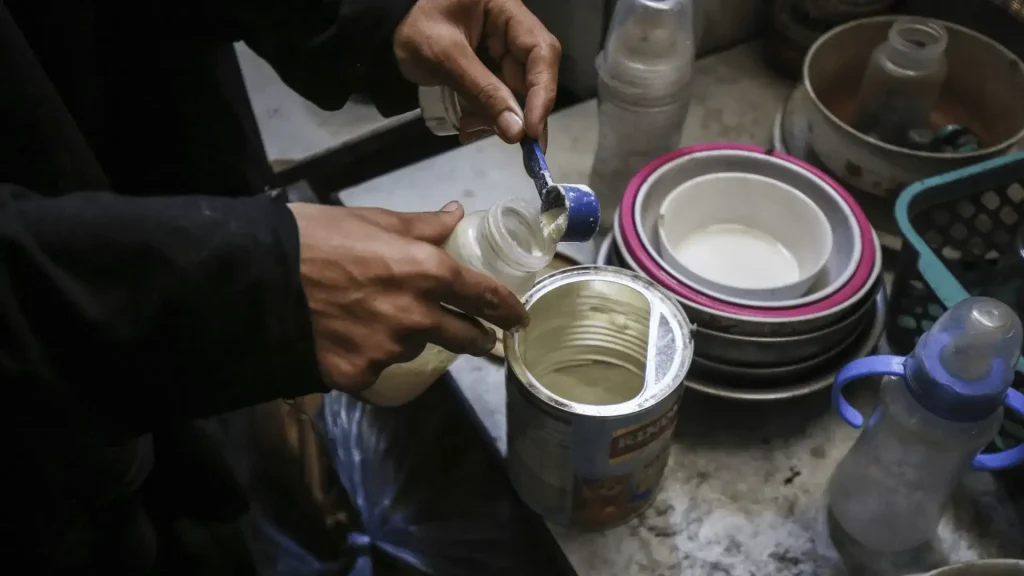
The throttling of humanitarian aid has both communal and specific ramifications on the population of Gaza when you dissect just how famine and malnutrition impacts pregnant women, mothers and young Palestinian children.
We are witnessing an intentional attack with generational impacts – and it may be too late to reverse the ramifications on Palestinian mothers and babies in Gaza.
The suspension of aid and basic supplies causes collective harm to the entire population of Gaza.
But in suspending aid to pregnant women, mothers, and young children, the state of Israel is effectively causing harm to all future generations of Palestinians within the blockade.
A pregnant woman’s body, even in the healthiest of environments, burns significantly more calories as the pregnancy progresses. By the time the baby is born, a woman needs at least an extra 500 calories a day to be able to produce milk to nurse her child.
When a pregnant woman doesn’t get the nutrients she needs, not only can the weight loss affect the development of the fetus, but the lack of nutrients can have severe impacts on both the mother and the child.
Recent reports show that the people of Gaza are surviving on about 1,400 calories per day on average; this number is about 67% of the recommended daily intake of about 2,300 calories. The situation has only gotten more extreme, with the World Food Progamme reporting that a third of the population is going without eating for multiple days in a row.
Without the proper nutrition needed to support the development of their babies, the mothers of Gaza risk a number of severe complications.
For mothers who are giving birth, the lack of adequate nutrition puts them at increased risk for bleeding in labor, anemia, and poor wound healing, all of which impact her ability to safely recover and care for her child.
Maternal health experts have said when it comes to severe starvation, it’s no longer just about weight loss, but also about all these nutritional deficiencies that occur. And then when the mom is in that situation, then the body is trying to preserve the fetus as much as possible. So a lot of that energy goes towards the fetal development.
But the crux of the issue is this: famine, man-made or otherwise, has lasting generational impacts. An attack on the nutritional needs of mothers and pregnant women is an attack on all future generations.
Studies have shown that hunger can affect not just the lifespan of an individual, but also the lifespan of their children and grandchildren.
The lack of nutrients can lead to neurological deficits, impaired bone development, and more irreparable harm to the bodies of infants. Their bones stop developing and their little bodies are unable to put on any weight.
On July 31, in a Reuters report from the children’s malnutrition ward at Nasser Hospital, in Gaza’s city of Khan Younis, Zeina Radwan, the mother of a 10-month old baby, explains why her baby is largely quiet and unresponsive. Doctors told her this is a symptom of malnutrition, a sign of the baby’s body shutting down.
Nasser hospital is one of four hospitals with still functioning wards for children, and during the course of the five days Reuters was present, the hospital admitted 53 more cases of acutely malnourished children.
The World Food Programme estimates that as of July 2025, over 320,000 children, the entire population under the age of five in the Gaza Strip, are at risk of acute malnutrition. The thought is staggering, almost incomprehensible.
Maternal health experts warn that past a certain point—even should a malnourished child or mother get access to aid— nutrients must re-enter the body with extreme care or face “refeeding syndrome.”
Once the nutrition intake is increased after a period of starvation, things begin to shift in a way that causes cells to break down, which causes severe electrolyte abnormalities. And in the case of a malnourished pregnant woman, the reintroduction of nutrients is often done in a hospital. She has to be under specialized care.
Drawing on the studies of past famines, such as the Dutch Hunger Winter from 1944-1945 and the Great Chinese Famine from 1959-1961, evidence shows that babies who endure famine both in utero and in early childhood are more likely to experience health complications later in life.
Children of people exposed to the famine were more likely to have high blood sugar, obesity and cognitive difficulties; their lifespans were found to be much shorter than their counterparts whose parents had never experienced famine or malnutrition.
It’s unrealistic to expect that, even should the borders of Gaza reopen tomorrow, the hospitals and aid organizations would have the capacity to support the pregnant women of Gaza with the kind of specialized care that they need.
And should the borders remain closed much longer, much of the population of Gaza is in danger of reaching a point of no return. Even should aid reach them, they face the very dangerous reality of refeeding syndrome and other ramifications of being cut off from basic necessities for this long.
Our organization, Every Pregnancy, has the resources, and is prepared with the necessities to help Palestinian mothers and babies in Gaza. As a coalition of more than forty organizations, our partners include Doctors Worldwide, Human Concern International, MedGlobal and the Palestine Children’s Relief Fund.
Through the support of our donors and contributors, our partners are working in over 20 countries to support the needs of mothers, pregnant women and young children. In Gaza, our partners work to provide prenatal and postnatal care, nutritional support and other critical necessities to supporting mothers and pregnant women. This work is crucial and must be allowed to continue to function at full capacity as soon as possible.
We cannot stand idly by. The people of Gaza need our help.
We are prepared to do everything necessary to support and assist our partners on the ground. Just let us in.